
Field dispatch / Algeria / 2024
When rain came
to the Sahara.
I went to southern Algeria to spend time with Tuareg hosts and the people who guide travellers through Tassili n’Ajjer. Then rain moved through the Sahara, closed the road to Mount Tahat and changed the trip.
By Mario Rigby · Tassili n’Ajjer · Tadrart Rouge · Ahaggar
Djanet / September 15
The road disappeared.
The road to Mount Tahat was gone. That was not the plan.
We had come south through Algeria with the mountain in mind. Tahat, the highest peak in Algeria, rises from the Ahaggar, the volcanic high country around Tamanrasset. It had been the clean objective at the end of the journey: reach the range, climb the peak, close the trip with a summit.
Then rain moved through the desert. Tracks that had been firm enough for vehicles were cut open or flooded. The mountain stayed where it was, but the road to it had been taken away.
The Sahara had changed the terms.
Essendilene / September 16-21
Hospitality as survival knowledge.
The trip began with the long transit from Toronto to Paris, then Algiers, and south into Djanet. The itinerary was clear: start in Djanet, move through Tassili n’Ajjer and Tadrart Rouge, then finish in Tamanrasset.
From Djanet we moved toward Essendilene, where I spent several days with a Tuareg family through the Mana Tribe concept. Mohamed was the local partner with Mana Tribe, owned by Sonia Osmani, founder of Tinariwen Tours. Moussa was our guide and translator. The bivouac team included Mohamed, Nadir, Taharo Elies, Ahmed, Hama, and Yakob.
I was shown how to wrap the tagelmust, the long cloth worn against sun and sand. Gear can be bought. Knowledge has to be carried by people. The tagelmust was shade, filter, identity, protection, habit, and history folded into one practical object.
In the desert, names are not decoration. They are memory, route, language, and belonging.
The field route.
The route began in Djanet on September 15, moved to the Essendilene host-family camp from September 16-21, crossed the Tassili n’Ajjer and Tadrart Rouge bivouac route from September 21-29, then continued by night flight toward Tamanrasset for the Assekrem finish on October 1 and the return north on October 2.
The field route included Tikobawin, Tilalin, Timghas, Adaik Stone Forest, Elberdj, Moul N’Aga, Tamzdiga, In Tihaq, Bouhdian, Wan Nagn, Tin Merzouga, Wan Iska, Adjlati, Wadi Indjaren and Tegharghart.
- Djanet / September 15
- Essendilene / September 16-21
- Tassili n’Ajjer & Tadrart Rouge / September 21-29
- Tamanrasset / Night flight
- Assekrem / October 1
- Return north / October 2
- Mount Tahat / Route washed out
Tassili n’Ajjer
A landscape that keeps records.
After Essendilene, we moved deeper into Tassili n’Ajjer, a UNESCO World Heritage landscape known for its prehistoric rock art and eroded sandstone formations. The country began to feel less like scenery and more like an archive.
Sandstone rose from the desert in towers, arches, walls, and narrow corridors. The correct language for these formations is differential weathering and erosion: rare water flow, wind abrasion, thermal stress, and sandstone hardness acting together over long periods.
Wind matters, but wind alone did not make Helicopter Rock.
The old Sahara beneath the present one.
Then came the paintings and engravings. Animals appeared in stone: cattle, elephants, and figures from a Sahara that had not always been this dry. Scientists often refer to this wetter chapter as part of the African Humid Period, the story sometimes called the Green Sahara.
The rock art does not just decorate the desert. It preserves evidence of an ecological world that changed.
I had come through the desert thinking mostly about distance. The rock art made me think about time.
The desert is easy to misunderstand if you only see it in the present tense.
Tin Merzouga
Dunes, water memory and the body.
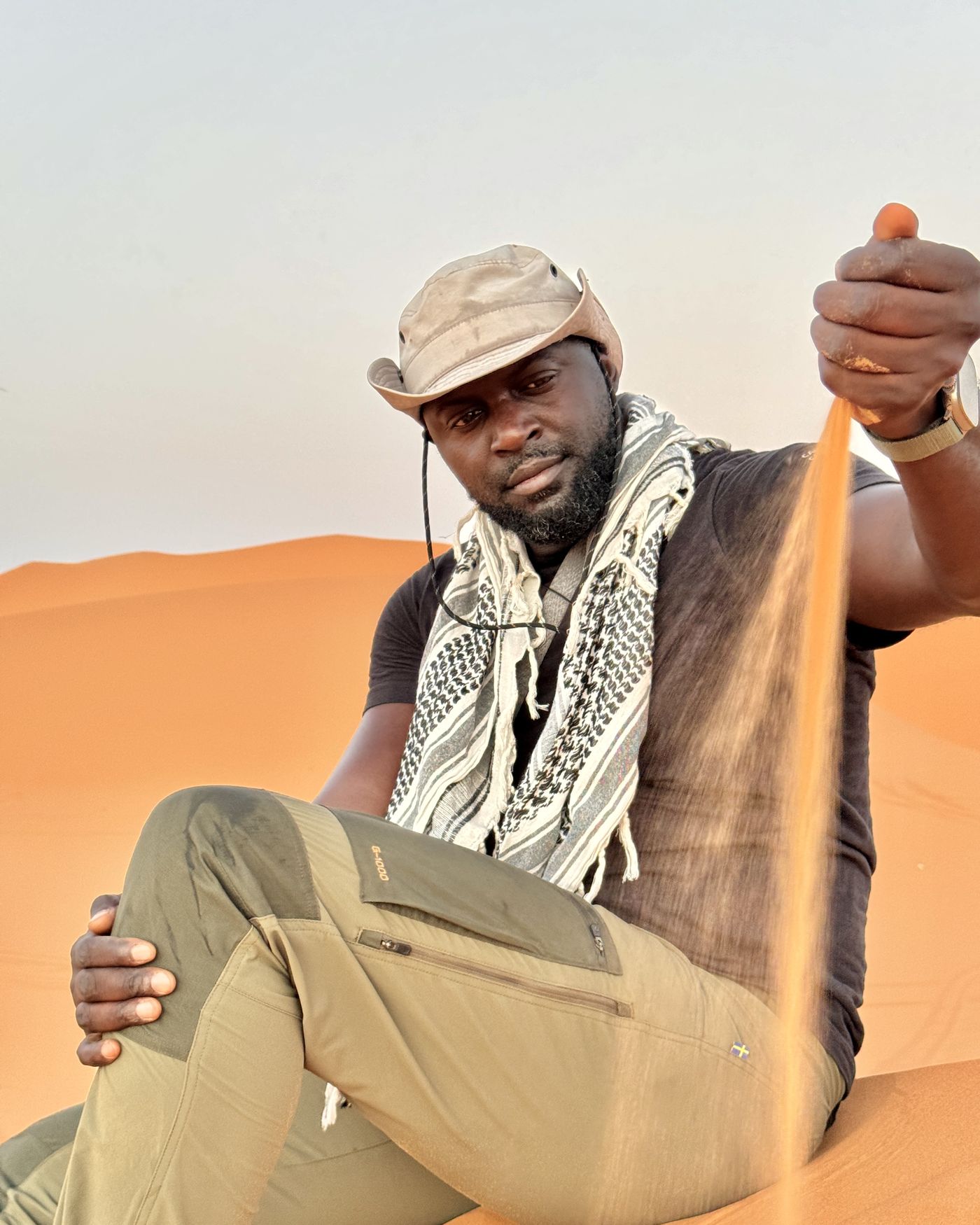
At Tin Merzouga, every climb took more from the legs than expected. Sand has a way of making effort inefficient. You push upward and lose half the force into softness. Step after step, the body learns humility without ceremony.
At a dry wadi, the ground pointed back toward water. The 2024 rain made that water memory contemporary. NASA’s Earth Observatory reported unusual September rainfall across parts of the Sahara, including areas of Algeria and Morocco. For us, the result was not an abstract climate note.
It was a changed itinerary, damaged tracks, and the end of the Mount Tahat attempt.
Assekrem / October 1
Finishing in Tamanrasset.
By the time we reached Tamanrasset, the mountain plan was no longer possible. The heavy rain had made the route to Mount Tahat impassable. Expeditions train you to aim at summits, distances, finish lines, and clean endings. But the desert had already been teaching the opposite. The meaning was not always at the top of something.
So we turned toward Assekrem. We woke early for sunrise on the plateau. The air was cold before the light arrived. The surrounding peaks held their shape in darkness, then slowly separated from the sky.
Near the hermitage associated with Charles de Foucauld, Assekrem carried a different kind of stillness. It was stripped down, but not empty.
The land was full of presence: geological, cultural, spiritual, human.
Return north / October 2
What the rain left behind.
The road to Mount Tahat had washed out. The summit stayed beyond reach. But Algeria had given me something more useful than the clean satisfaction of a completed plan. It had reminded me that the desert is not empty space between destinations. It is memory, pressure, hospitality, stone, water traces, interrupted ambition, and people who know how to live with uncertainty without needing to conquer it.
I left with photographs, but the thing I carried most was quieter: a changed sense of pace, a deeper respect for water, and the knowledge that sometimes the journey becomes honest only after the road disappears.


Coming soon Photobook / Algeria
Algeria.
Tuareg heartland.
My hardcover photobook from the heart of the Tuareg Sahara, with two images never released before.
Signed and numbered. Only 100 copies.

Local knowledge & sources.
Local team: Mohamed (Mana Tribe local partner), Sonia Osmani (Tinariwen Tours, Mana Tribe), Moussa (guide and translator), and the bivouac team Mohamed, Nadir, Taharo Elies, Ahmed, Hama and Yakob.
The journey depended on the people who knew the land. Cultural heritage calls for local guidance, respect for rock art and care with water and waste.